The invention and use of the mariner’s compass
Book of EstherThe invention and use of the mariner’s compass marks the point at which the ocean ceased to be an impassable boundary and became a route by which ships could reach distant lands. The author treats the compass not merely as a practical instrument but as a provision of Divine Providence: its discovery and adoption, he argues, equipped navigation to carry the Gospel toward nations previously beyond reach. The decisive contrast is between a prediction that the Gospel would be preached throughout the world and the navigational limits that, without a reliable guide at sea, seemed to make its fulfilment impossible.
Before the Compass
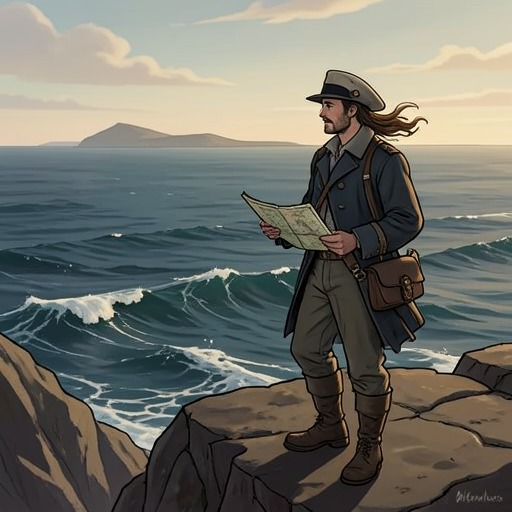
Before the compass, the sun and stars were the principal guides for ocean navigation. The most daring sailors did not venture beyond sight of land; long voyages proceeded slowly and dangerously by following coastlines. In this account, the obstacle was not simply a lack of courage. Navigators had no dependable means of finding their way across open water, and the farthest countries and islands remained inaccessible by ordinary seafaring methods. The author stresses how remote such travel once appeared: a voyage to lands on the other side of the globe seemed no more feasible than a journey to the moon.
That limitation gives the invention its force in the book’s argument. Jesus Christ’s pledge that the Gospel would be preached among all nations had been made when half the globe was unknown to Europeans and no known navigational method offered a way to reach it. The compass enters this gap between promise and apparent possibility. It does not itself preach or convert; it changes the conditions under which people can travel, opening a route to scattered islands and far-off shores.
The Magnetic Needle and Its Use
The account describes the instrument through the property of the magnet: it can impart to an iron rod the tendency to point toward the earth’s poles. Flavio Gioia, identified as a citizen of Amalsi in the kingdom of Naples, is credited with recognizing the phenomenon’s navigational value and inventing the nautical needle. The author dates the convergence of discovery and practical invention to 1302, presenting it as the moment when a previously hidden property became a usable guide for seafarers.
Once equipped with the instrument, navigators could steer through the ocean rather than depend on coastlines or visible celestial guidance. The text depicts its practical consequence as access to the globe and its dispersed islands: ships could cross the trackless deep and find their way even in darkness. This is a substantial change in the scale of navigation. The compass turns the sea from a space that sailors could enter only cautiously and within familiar limits into a medium through which distant places could be connected.
The author includes an important qualification: the compass is said to have been in use in China from a very early period. That notice complicates any simple claim that the instrument originated exclusively in Europe. The argument’s emphasis falls instead on the discovery of the magnetic property, the recognition of its advantage, and the timing of its use in the navigational history that the author traces. The text’s providential case depends on the instrument’s historical function and moment, not solely on assigning its first use to one place.
A Providential Turning Point
The author reasons that an invention necessary to make a divine prediction practicable must itself belong to Divine Providence. In this reading, the compass is as truly a divine provision as if it had been delivered from heaven by an angel. The language raises a technical advance into a sign of governance: the instrument’s importance lies both in what it does for sailors and in how its appearance fits the larger course of history.
That interpretation also distinguishes divine purpose from the character or religious allegiance of the people through whom events proceed. The compass, the author notes, came into use in an age that did not enjoy the Bible; this fact does not, in his view, establish the credit of the Church of Rome. Rather, God can serve his purposes through the abilities, and even the crimes, of his enemies. To underline the point, the text places the compass alongside the crucifixion of Jesus Christ, which it describes as salvation for his people, and compares the usefulness of David Hume’s atheistical labors with that of Martin Luther’s. The comparison reinforces the book’s wider claim that the means of a providential outcome need not be consciously chosen by its beneficiaries or agents.
The Compass in the Larger Sequence
The compass did not immediately produce a rapid age of discovery. Although the author says it had placed the key to the world in navigators’ hands early in the fourteenth century, nearly half a century passed before sailors ventured into new seas, and navigation at the beginning of the fifteenth century had not advanced beyond the level reached before the fall of the Roman Empire. The invention therefore begins a sequence rather than completing it: the instrument exists, but experience in using it and the further movement of exploration are still required.
The book identifies 1302 as the point at which a thousand converging circumstances came together, in time to assist the navigators of the fifteenth century and prepare a theatre for the revival of the Gospel in the sixteenth. From there, the discussion turns to the Portuguese voyages and the discoveries associated with Columbus and other navigators. The compass’s narrative significance is thus both practical and structural. It supplies the means for crossing open water, while its delayed use links an advance in navigation to the expansion of geographical knowledge and, in the author’s account, to the worldwide reach promised for the Gospel.